Hello friends,
In this week’s email, I share some thoughts about living with chronic pain. But first, a few announcements about upcoming events.
Join me at the next Awareness in Nature events on Saturday, June 13th at 10 am in my backyard in South Acton (email me to RSVP) and Saturday, July 11th at Nara Park in Acton (register with the Acton Rec Department). Details are below.
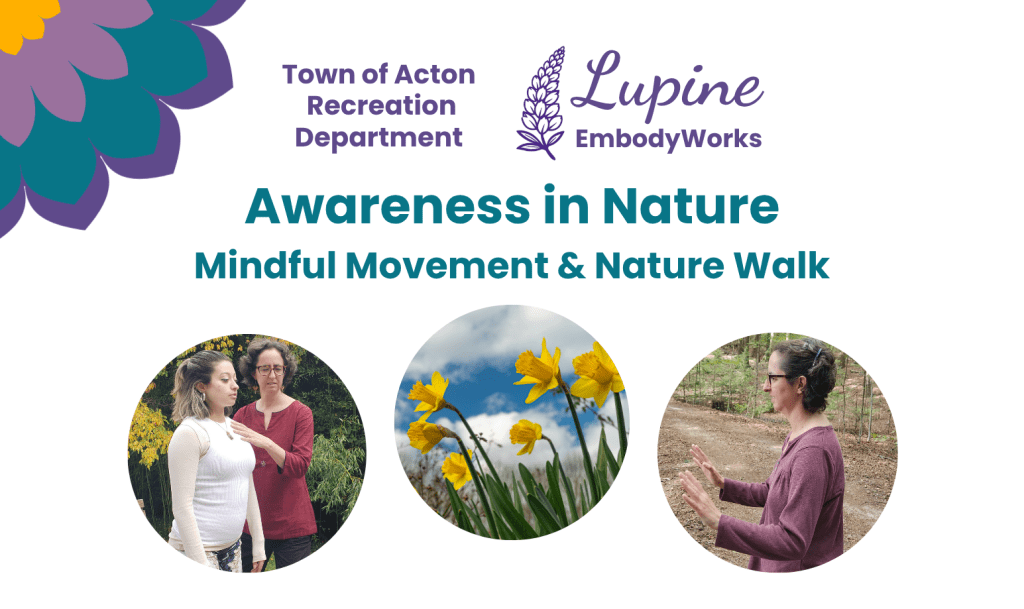
When: Sat., July 11, 9 – 10 am
Where: Nara Park Amphitheater, Acton, MA
Cost: $20 per person
What: Group mindful movement class followed by a nature walk
And save the date for a Somatic Resilience Practices for Parents workshop on Wednesday, June 24th, hosted by the Acton Boxborough Family Network (ABFN) at Illuminated Birth in West Acton. (Link for registration is below. I believe you need to be a member of ABFN to attend).
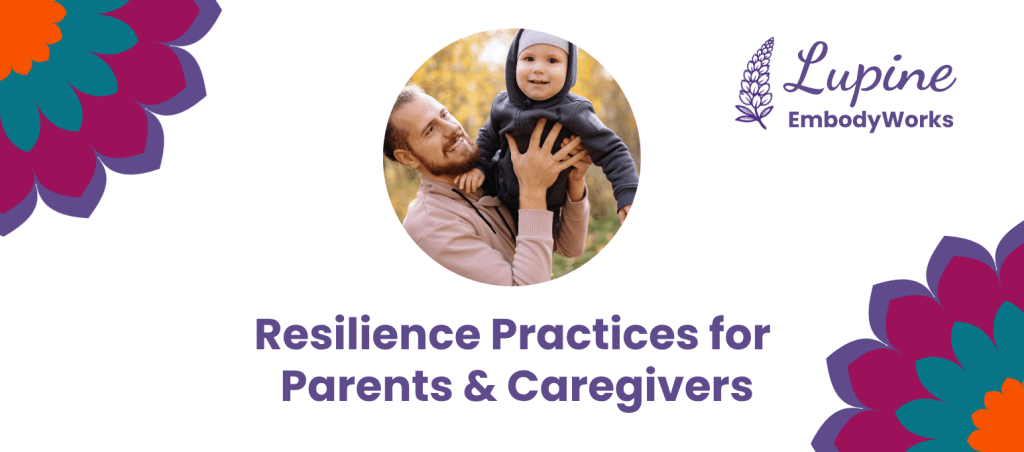
When: Wednesday, June 24th, 7 – 8:30 pm
Where: Illuminated Birth, West Acton
Cost: $30 per person
What: Take some time for yourself to rest, reset, and learn embodied awareness tools to manage stress!
A few thoughts on pain: a personal story
There has been much written in recent years about pain management and the benefits of holistic approaches. I won’t offer an overview here; you can read about some of the scientific research about AT on this website and here is a recent article about the Alexander Technique and pain management.
According to the US Centers for Disease Control, “In 2023, 24.3% of adults had chronic pain, and 8.5% of adults had chronic pain that frequently limited life or work activities (referred to as high-impact chronic pain) in the past 3 months.” In other words, chronic pain causes significant personal and societal disruption.
I started AT lessons as a teenager because of a sports injury that led to chronic pain, which affected my ability to play the violin. Many people ask me if I have gotten back to playing the violin, or if I can do the activities I used to do.
I have always struggled to answer that question coherently, and I think I realize why. Another question seems more relevant: “How has your relationship to pain changed?”
Getting injured during those formative teenage years and losing the ability to easefully create music–these events deeply impacted my whole life. On the surface, the injury affected a specific physical part of me. As I journeyed through the healing process, I experienced deeper and wider reverberations. The injury impacted my artistic and somatic expression, my social life, my identity, my confidence, and my sense of self-worth.
After the initial period of recovery, I became very scared that I would reinjure myself. I felt “broken” and “not whole,” and somehow convinced myself that I would never heal.
A feedback loop developed in which the muscular tension associated with those thoughts and beliefs led to more sensations of discomfort and pain. In an effort to protect myself and prevent future injury, I was getting in the way of my own support system. (I now know some fancy technical terms for that system, but let’s leave it at that).
I have spent many years attempting to get back into playing the violin. Many of those episodes have left me frustrated and disheartened. I get stuck in a cycle: I muster the courage to pick up my instrument, I play a few scales and simple melodies, I sense the old patterns arising, I get scared I will hurt myself again, and I put the violin back in the case for a few more months.
Until I went through my teacher training program, and I discovered the missing piece in my recovery process.
Hodges, Cohen, and Cacciatore, the authors of the study linked above, state it this way: “We have seen that there is little direct correlation between tissue damage and pain and that pain is the action of a protective system that includes neural, biological, and psychological mechanisms.”
When we sense pain, our system is alerting us to imminent danger. It is a protective mechanism meant to direct our attention and focus our energies. The system can continue to work, and overwork, long after the damaged tissue has healed.
To be clear, these findings do not imply that the pain is “all in your head” or is “only psychological.” My takeaway: we have more agency in managing the pain through a process of gradually teaching our whole system that we are in fact safe, out of danger, and on solid ground.
Which brings me to zip lines.
Because of the teenage injury, I have spent the last few decades avoiding downhill skiing, tennis, martial arts, and any other form of activity that I deemed “too dangerous.” In other words, long after the tissues healed, I was stuck in fight or flight mode, choosing to protect myself in order to avoid potential pain.
It’s a long story, but this past weekend I found myself at Ramblewild outdoor adventure park in the Berkshires with my 9-year-old child. We signed up for four hours of climbing in trees, navigating obstacles while suspended a few stories in the air, and zip lining across a deep ravine. Did I mention that I usually experience vertigo when I approach a cliff?
What was I thinking???
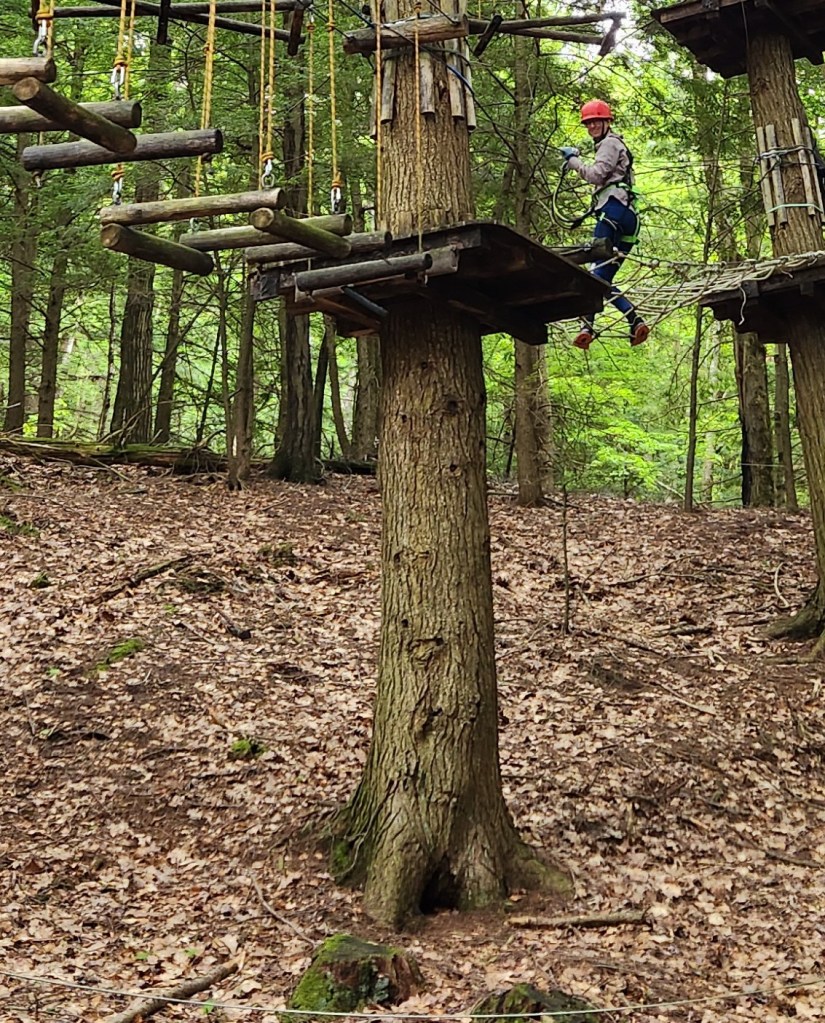
As I stepped onto “paths” of narrow logs connected to each other by thin metal ropes, I had a lightbulb moment. All of the work I have done in the past few years to establish my own connection to the earth, in this gravitational field, was making a difference.
Even thirty feet in the air on unstable footing, I was aware of support.
I could double check the belay; touch the metal ropes; look down, or more often forward, to see where I was headed; use my proprioceptive sense to notice my postural support system in action; take a beat when I noticed my heart racing; take a break when I needed a snack and the firm forest floor.
All of this sensory awareness and inhibition-in-action brought me into that specific present moment so that I was processing more of the actual situation in front of me, rather than overwhelmed by my fears related to a situation from my past.
My protective system has regulated and recalibrated to align more closely with my current reality. I may not be ready to play a Mozart violin concerto any time soon, but I do feel quite a bit healthier and more whole.
The best part: I spent four joy-filled hours with my child, made some new friends, and felt more alive in my own body than I have in a long time.
I hope that this personal anecdote gives you a window into understanding how mindfulness and somatic movement practices can potentially support people living with chronic pain.
Everyone has their own story and their own path through the healing process. For me, what has helped is a holistic, integrative approach grounded in both a scientific and human understanding of how we establish safety, support, and wholeness.
With gratitude,
Hannah

Reviews help me get out the word!
Visit my Google profile and leave a comment, if you are so moved.
Thank you!

Leave a comment